The Twelfth Arrow
J.R. Watson
The French and Indian War
North America
1754—1759
A time not that long ago half the world met the other. And just as things have always been, man’s hunger for control led to death, injustice, and eventually— total war.
The North American continent— the New World— was carved up by the empires of France, England, Spain, and the Dutch. Contending with each other and an elusive and canny indigenous force, territorial boundaries and their owners changed hands often. The state of affairs in North America as it is today was by no means a certainty. And the outcome balanced precariously for many years; and especially during a tense few months in the summer of 1759.
Divinely, the fate of New France and the American colonies in British North America would not be decided by kings, infamous tyrants, wooden armadas, or armies with a hundred battalions. It would be decided by crafty guerrilla warriors, frontiersmen, colonial militia, second-rate generals, and, predictably, the unforgiving and wild Canadian terrain.
A plethora of sources exist to read about Virginian Major George Washington (yes the future first President of the United States) and how his defeat at Jumonville Glen started the giant conflict in May of 1754; or about British Major-General James Wolfe, and his months-long siege and eventual capture of the city of Quebec, the gates of Canada, against French general Montcalm, culminating in his death, boththeirdeaths, and the British-American victory known as the Battle of the Plains of Abraham (1759).
Scholars and historians have captured it all in detail. There is no shortage of official records and personal accounts of the war ravaged periods during the 18th and 19th centuries in the New World. They account the names, places, dates, strategic concerns, supply routes and logistics, political ramifications and blunders. The weapons, the ships, the orders, the men and their possessions. The indigenous forces, who they were aligned with and when, how they fought, and how they lived. Exact in detail and taken mostly from firsthand sources one can read all about what happened. But— history isn’t only about what happened. Stories show us what it felt like for it to have happened, to live the history through the eyes of another.
These special and rare accounts do exist, like a shipmate’s diary or a general’s personal letters home. And, like the case of this story, a story that is hard to define, for when it was discovered and finally read; some said it was a story about connection and family; others said it was about God, or hidden powers; but mostly they said it was about love, and, they also said, it was about the possibility of what could have happened when the two worlds collided.
The story of Ashka Migizi was found in a molded trunk unearthed from stone ramparts from the forgotten remains of the French Fort of Frontenac, site of modern day Kingston, when excavators were stripping the earth for a new Sears in 1964. One hundred and fifty years after they were written and Two hundred and ten years after the events they described.
When the leather-bound trunk was finally cracked open it initially appeared to only contain one man’s 18th century war fighting equipment; a mix of well-crafted indigenous weapons and clothes, British-American firearms and shot, and French troupe de la Marine tools and uniforms. But upon further investigation by the Royal Ontario Museum, they discovered a false bottom in the rotting chest. And stuffed into the tiny sealed space was a stack of handwritten letters bound in leather. A large eagle’s feather and a small stone arrowhead were tucked into the thin leather ties and rested neatly on top. The leather cover had no markings and was deteriorating. Inside the leather flap and scrawled on a single sheet of now yellow-brown paper were the words “The Twelfth Arrow”.
The letters tell a story that takes us through what some today call the Seven Years war but was mostly referred to as the French and Indian War. A war that spanned not just the entire eastern North American continent but also ravaged all of Europe and the Atlantic seas. It was the first true worldwar— as Winston Churchill was quoted as saying many years later.
The story reveals some painful truths and also some timeless lessons. It appears to have been written during the War of 1812, but the scholars debate this.
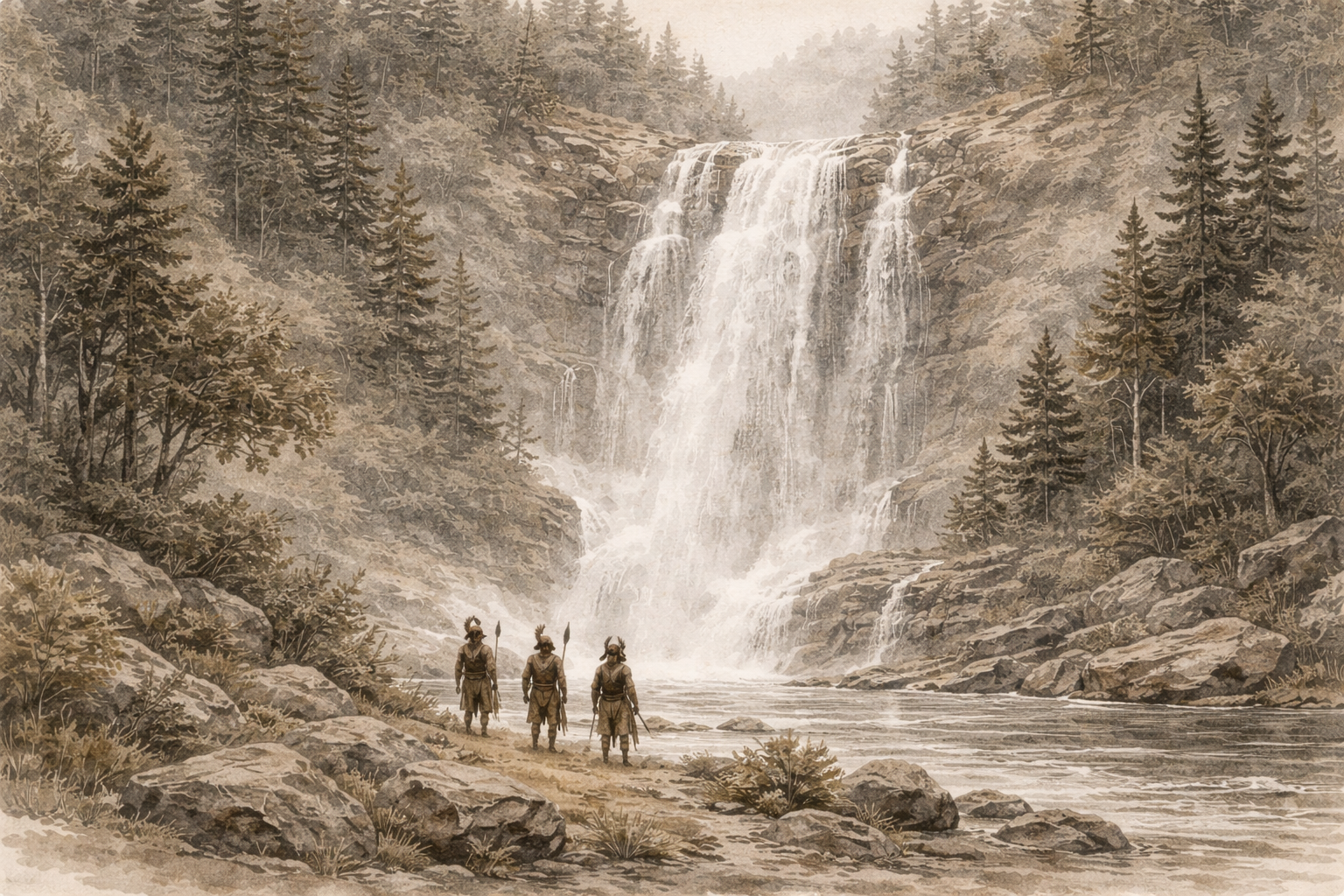
“A time not that long ago half the world met the other. And just as things have always been, man’s hunger for control led to death, injustice, and eventually— total war.”
Part 1
Into The Deep
“The moral of the story is to pay attention.”
May 1754 - July 1755
One - Life & Death
This story is about how I lost my life but found something real. In fact, you could say I died twice; but we’ll get to that.
I do believe that my story should be told. It holds keys to our world and lessons for our children and the generations to come. It can help, if not you, now; then someone— somewhen.
It’s true what they say, I was there, at the deciding battle. And despite what the storytellers and kings of the future will say; the war for the continent was decided by Indian warriors and young frontiersmen on the edge of the known world in wilderness that would end European aristocrats. I don’t think they will ever understand how little influence they truly had.
The war for the New World rested in our hands.
My wife has long since passed into the afterlife. She encouraged me to tell my story but I never could. I am old now and don’t know how much longer I have. I’ll write to you my story, everything I can remember. Hopefully you’ll find in it the answers you’re looking for. All I ask is that you see to it that my story lives on, that the souls in the future understand what happened here, what happened in Quebec, and who walked the land under their feet before them. We are connected.
I believed in two worlds; good and evil, heaven and hell, light and dark. Then, years later, I didn’t. It became more like the inside one and the outside one; connected by things unseen by man. A worldview— no, a knowledge— a knowledge about the world and our place in it. A knowledge of how to live; and how to die. A knowledge of the universe and the spirits within; a knowledge I must tell you about now. And there is much to tell.
I was taken, a slave to the Algonquin far-Indians of the Great River in Upper Canada. They were Anishinabeg— Original People with their tongue; relational to the Ojibway’s. Excellent warriors and travellers of the land. Savages to the white man. They say that the white man treated the Indians worse in those days, but that’s not my memory. It’s worse today. Back then, the French respected the native’s prowess in reconnaissance, warfare, and hunting. And traded and fought alongside them as equals. I cannot say the same for the English or for the Americans whom they spawned.
I was taken by an Algonquin band who had a spiritual connection with the northern lands and the animals within. The Kitci-sipi-rini— The People of the Great River, or simply, The Sipi, as I will refer to my band henceforth. The Sipi would take me to another world, to the Great River and beyond.
Their skin was dark red-brown, tight, rough on the edges, cracked from the sun, and thin enough to see their muscle fibres. Teeth were often missing but the ones that remained held their condition well. They stood average height or shorter and carried dark eyes surrounded by a yellowish-white. Long and oily black hair was ubiquitous, most used animal fats to keep it in a shiny condition, men and women alike wore it long; often in braids or knots. Men, braves, shaved the sides of their head and often portions of the top, their long braids extended from the crown of the head, facial hair didn’t grow and if it did it was always cleaned up. Most men had an equal number of tattoos and war wounds.
Deer or moose hides were stitched together with threads if available, sinew if not. Moccasins, mittens, caps, jackets, and dresses for the women were done in this fashion; and beaver or rabbit furs were used in the linings. Breechcloth, leggings, wool sash-belts, and other wool items were traded for often. Embroidery and beadwork were common. Small shells, beads, feathers, and hand-crafted dyes were used for the decorative work. Men used red dye for war-paint.
Their language was spoken fast, but they spoke less; the tones and sounds seemed to have been drawn from the animals and land they worshipped. They carried a collection of items, a balance between ceremonial and the practical. When I was taken almost all Indian bands used European goods and clothing. I did not witness a band who resisted their influence, we all used their modern tools and weapons, even in those northern reaches where the white man begins to speak English again.
I was handed over to two Algonquin men from the Sipi on the 28th of May 1754. And they took me. They took me to a new world, the so called savage world. I was seventeen years old.
Kitchi and Nootau were the two men who took me.
Kitchi: Kitchi-Manidoo-naabe, The Great Spirit Walker, or Great Spirit Traveller, would be approximations in English. Kitchi— the great, is a short hand used for him. Similar to paying respects to our respected elders, but not simply because of their age; Kitchi— the great one, noble father, the old wise one. It was also the name used when referring to their ‘God’, The Great Spirit— Kitchi Manidoo. In native culture names are given at specific times for specific purposes. The names are more than placeholders or references to long lost saints. For them, there’s a link between the name and what it represents and who it is bestowed upon and why. For Kitchi, it couldn’t have been more apt. And for what a name like that represents, every member of a band would respect it, even if they didn’t respect the man. In the case of Kitchi, it was both.
Kitchi was tall and barrel chested. His overall size and width was much bigger than the average Indian or white man. I often imagined him in the centre of a Roman legion with a golden chest plate and legionnaire shield, swinging a mace or long lance at ravaged lions or the barbarian hordes. A scene that seemed better fitting to his size and stature. He had a tall head, a big forehead, and a rare thick chin; his face blank and expressionless. His hair long and neat, a mix of black and grey, he never braided it. Kitchi’s hands were double the size of a normal man’s.
The other man that took me was Nootau— Nootau-Gaabow: He Who Burns and Stands Firm, or— The Fire-Burner, The Burning One; Nootau. He was younger than Kitchi and of average size. He had wiry muscles that twitched on the surface of his skin and a pointy hawkish face, like an eagle or bird of prey. Sunken eyes that could pierce and a long braid of hair extending from the back of his skull; the sides and back of his head shaved to the skin and usually marked with red dye. A scary sight. And he wanted me dead from the moment we met.
Kitchi didn’t speak often but he communicated. He viewed words to be used last. His actions, his presence, and the looks he gave communicated a great deal. It was a remarkable feat I witnessed on many occasions.
Nootau was the opposite. He often spoke first, fast, and loud. Regretting things he said but covering them up by other words or new actions. His movements often reminded me of lightning; a movement initiated and completed before you were fully aware of what had happened. I often felt a lot of his actions, especially those in anger, came and went like lightning for him as well, like he wasn’t in control. I watched him often. Sometimes I could see this energy in his body, even sitting on a stump on a quiet day, I’d see his fingers or sometimes his legs bouncing and vibrating like a woodpecker— whose sharp beak and pointy head feathers weren’t too dissimilar from Nootau’s angled face. An angry bird looking for prey to pick apart for no other reason than it can. If Nootau was the sharp quick crack of lightning, Kitchi was the slow heavy rolling thunder that followed.
I was taken to a lake that we called Jack Pine Lake. It was the spring, summer, and fall camp of the Sipi. The lake is in the watershed of the Great River (Kitchi Sibi), now called the Ottawa. The Algonquin Sipi called the tributary Mada-was-ka Sibi, and it extended westward from the Great River and up into the dense forested highlands.
The entire basin of the Great River and its tributaries is a vast inland area of water, rolling peaks, lumps of bedrock, and valleys. Everything is covered in green-growth and thick trunks hundreds of years old. I did not witness any cutting; that began in your time. The only areas not covered by endless forests are water. And there is much water throughout the land. Interconnected lakes, rivers, streams, ponds, swamps, bogs, and back channels. And the Sipi knew them all.
This is the reason why the natives of New France constructed lightweight canoes and boats made of birch and spruce. An invention that I found special. A requirement for travel in the north woods. The other requirement was deep knowledge of the terrain, forest, waterways, a knack for way-finding, and a knack for war-fighting— or staying alive. Every Algonquin clan has dozens of stories of relatives paddling around a bend in the river never to be seen again. Even if a man had an excellent sense of direction and resourcefulness, there were many ways to die alone in the dark green Algonquin forests.
I once knew a brave who was badly attacked by a cougar and then a full-grown male black bear on the same day. He survived by plunging his fingers into the large cat’s eyes as its teeth cracked into his skull. He had two small holes in the top of his head. And that is to say nothing of the Wendigo and the other spirits— but I’m getting ahead of myself.
Principally, the territory of the Algonquins that lived in the north on the Great River and its tributaries was unforgiving and deadly. And cold—bitter cold. In the spring and summer game and fish are plentiful. Harvesting is relatively simple if you know what you’re doing. And the Algonquin plant squash and and corn when the soil permits to supplement their diet. The fall and winter is for hunting, but the winter is also a test of your will. Every year is a game of starvation and hope. It could generally be considered a good winter by a band if it had lost only one or two members during the winter. This is usually to starvation, but sometimes to cold and sometimes to falling through the ice. And sometimes, men go mad.
The winters start early. Sometimes the snows come a month or more before the days stop shortening. The snows come heavy and don’t let up until the spring, and even then they try and stay around. Once the winter sets in the lakes are frozen solid with an arms width of ice, the snows pile up to half a man’s body or more, and then a sharp and deep freezing sets in until the equinox.
This means conditions for travel are extremely difficult, and basic tasks like hunting, fishing, foraging, or even just staying warm, take fortitude. Some would say a manly fortitude. I met only one European woman during my years with the Sipi in the north, and she was a colonel’s wife in Fort Frontenac, holed up in a stone house with a hearth. But this is a false belief, the women and children of the so-called Far Indians have an inner strength and a quiet solemn attitude while withstanding brutality and hardships. A quality that I do not see in many white men, especially today. But this is a requirement for life above the Great Lakes.
The warm months were much different. The sun was warm and the days were long. We hunted and played games, and we made friends and we made lovers. There were ceremonies and many stories to be told. We learned from the land and we learned from the spirits. We came together like animals, like we always did. If it wasn’t for war and winter life would be a delight. But I suppose that’s not the point. “A path with no hardships leads nowhere.” Kitchi once said to me. And that stuck with me. Most of the things he said did.
In the mornings the yellow sun would rise and bring about the birds and the bugs, the rodents, the beavers, and the bear; and it would shine on the slopes for the deer. The wind would begin to tilt the tree tips; waking with the sun; it would flow to her from the west, breathing air into the forest, into the animals, and into us. We’d eat and we’d laugh. We’d hunt and we would craft. And in the evenings the red sun would set. We’d gather ‘round the fire and settle. We’d give thanks to the day, give thanks to our friends; human and natural; and sometimes we’d dance. We’d dance until the sky turned black and the stars came out to play. They’d tell us more stories; stories of our past, stories of who we are and where we’d come from. And sometimes if you were lucky, maybe they’d tell you a story about your future.
Two - Capture
I’m getting ahead of myself.
The natives of this land did not welcome me with open arms. And my own behaviours and thoughts were of such a different sort, it prolonged my anguish and suffering during those early years. A friend once said to me years later that it was like I was a newborn child. Foolish and stupid. Not yet aware. Resisting things it needs and biting the hand that feeds.
But I was young. And the events that took my freedom from me happened very fast. In less time than it will take you to read the next few pages.
I was a carriage-boy and aid to the Quartermaster during George Washington’s expedition to Ohio in spring of 1754. Our task was to warn and remove the French and their Indians counterparts from expanding their control in the Ohio river valley and its tributaries. The accounts I’ve read about Fort Necessity and skirmish on the 27th of May are mostly true, so when Washington failed and our party broke apart, I was given as a war-prize to the Algonquin. Force was not needed, what was resisting going to accomplish? I had only sincerely prayed one other time before that, and when it happened I prayed. I prayed for a quick and painless death— but that’s not their way.
In the haste of our retreat from Fort Necessity, the French and the Indians used their position of power to pillage us for whatever they could. Taking war prizes after a successful battle was sacrosanct to the Algonquin and other native nations. They don’t share the same ambition as the European man to conquer land, stake out their claims and shove flags into hillsides and bastions. Someone like this Napoleon and his conquest of Europe is difficult to comprehend for the Indian. Land is not theirs for the taking. The native seeks victory in battle, they seek status, they seek balance. Taking an enemy’s spirit is far more important and practical than taken the land. They seek prize, and taking or torturing people was a much preferred prize.
Washington tried to negotiate. The Algonquins held three men captive as our camp packed and collected our wounded in haste. Two of the men were British regulars and it would look bad on Washington if they were taken, or worse, tortured to death in front of us. I could hear the screams and whooping hollers from the braves surrounding our camp. They were getting excited for their war prizes. And you must know, it’s not like today, the Indian practice of slowly torturing their captives was a tool for them, one they were proud of. They didn’t care, or shall I say, understand, how much it affected their image in the European mind; a barrier to normal relations that has now started to end.
But not then, and certainly not at Fort Necessity in 1754. Here I first witnessed the barbarous method of removing someone’s head skin; scalping. Traditionally, the scalper would begin by carving from just above the eyebrows and then tracing his blade over the tops of the ears. down the back of his skull, and then up and around the other side. The scalper would then tear it off by pulling at the fresh edges, sometimes with a tool or the help of another man and a boot on the back of the victim. Most often these scalps were kept as a trophies. That evening in the glen, I didn’t see it— I heard it.
I dashed into the Quartermaster’s tent to began packing after Washington’s retreat orders. Outside, the Algonquin braves began to cut and yank off the top skin of Mr. Potter, a friend and aid to George Washington.
Mr. Potter was elderly with thinning grey hair, scratched spectacles, and an obtuse round head that didn’t quite match his thin body. Mr. Potter screamed like a woman when they started to cut. Laughter and hollering bellowed out from his torturers. The sound was only a dozen or so yards on the other side of the canvas from me. I could hear grunts and clangs from their war-equipment as the Indians struggled to scalp Mr. Potter. The sound of his scalp tearing free was loud but not loud enough to cover the retched screams and watery cries coming from Potter himself.
Every man within earshot of something like this feels the same: a lightning strike into the chest. Dread that washes up and down the body, your stomach wants to empty, your fingers and limbs feel lighter, less real, less available for pain. Usually you freeze. And hearing Mr. Potter scream as his scalp and hair was removed sank me into a cold and terrifying pit. No sooner did I fall into that pit of terror did my new life begin— and it began abruptly.
“Quick! You, move outside!” A junior officer hollered. He was hunched over in the opening of our tent, a tattered bandage across one eye. His one eye was looking in my direction. The sour smell of burnt gunpowder rolled over his shoulder and into the tent.
“You, you’re the Quartermaster’s aid?” He asked. His voice was hurried, jumpy. I looked at the Quartermaster for a sign of what to do, he was red and sweaty and didn’t even look up from the trunk he was stuffing. There could be no good reason why I was needed at that moment. And the scream from Potter still echoed between my ears.
“No.”— I said.
Considering the stakes, it was worth a shot.
I kept my eyes on the young one-eyed officer still half-crouched and holding up the flap. Behind him the sun was setting, I could see smoke and frantic movements in the red and yellow light. Another scream. A scream mixed with cries. Dead and lifeless screams into ears that can ill afford to listen.
The officer looked at the Quartermaster and then back at me. “Yes you are. Hurry, follow me!” And he turned out. I looked back for reassurance from the old Quartermaster, but he was curled over packing items that didn’t belong together into a wooden trunk; his dirty white cotton shirt was slicked with sweat and stuck to his bulbous body. He didn’t look. Even as a boy I knew that when death is in range most men become franticly opportunistic. They’re petrified. And that fat petrified old Quartermaster was the last Englishman to speak to me for many years;“Godspeed,” he mumbled, and I stepped out of the tent and into chaos.
A crescendo of war-whoops cascaded through the camp. I squinted in the light, the turbid smoke hit my nostrils and mixed with that sour-burnt smell of gunpowder. Our camp was in open area shaped like a bowl, around the edges the ground was slightly higher and had a mix of trees and, presumably, hidden Indian warriors. The wind was picking up and the trees swayed and bent over; the stormy sounds masked the screams of men. The fires were growing from the wind and the plums bent down to tent level. Even nature wanted us out of there.
Our camp was completely surrounded. In the centre was some low ground where a group of French soldiers and their Indian counterparts were discussing the terms with our side; Washington and two British officers; one who looked badly wounded, and adjacent to the negotiations in a ditch guarded by a few braves was the partially alive bodies of Mr. Potter and two British regulars.
Before I can make sense of it, the young one-eyed officer clenched the scruff of my collar and began to walk me towards the negotiating parties. As we approached the conference, the British Major standing next to Washington turned his head, searching for something he expected to be there. Seeing me and my escort coming down the hill, he raised an upturned palm and impatiently waved his figures towards himself— come, hurry. He turned his head back to the conversation. Washington never looked.
There were five or six braves standing over the bodies in the ditch. Seeing me, Two of them stammered up the hill and grabbed me, it was Kitchi and Nootau, one on each shoulder, and they dragged me in such a way that only the tips of my boots skimmed the dirt beneath me. Their fingers digging into my shoulders. They smelled sour. Their breathing was fast and hot. Their red skin looked old. I am ashamed of the pleas that escaped my mouth; it had no effect. I sounded like a child.
As they hauled me past the conference the British Major turned and pointed directly at me as he conferred with a short moustached French officer of a high rank. My fate sealed. And I’m dumped into the damp ditch that wasn’t wet from water. I watched them release the two British regulars whose lives have been exchanged for mine. And they scrambled up and out of the muddy hole. Their boots slipping and grinding on the rocks and dark dirt as they climbed away from certain death. The Indians laughed.
I’m lay next to Mr. Potter. His head and face a mess of dark red. His body pocked full of holes and burns, a brighter red leaked from his abdomen. He’s almost gone. His breathing is fast and short. He’s the first dying man I see up close. I close my eyes and pray. I’m at the gates of hell. The only thing I wanted was to live. But for some reason I prayed for death.
It was clear that I was exchanged for the lives of two British officers. Oh, how time changes relationships. But what wasn’t clear for quite some time was why I wasn’t killed or tortured on the spot like Mr. Potter. What came over time was much different.
I don’t remember the short time after the exchange, but rather quickly I’m lead by Nootau and a group of Sipi warriors out of the forest and towards their canoes.
Along the river’s steep banks I slipped on mud and fell on my face. My hands dug into the rocks and mud; my fingers instinctively clawed the earth. Nootau grabbed my collar and pulled. His lips pursed into an evil half-smile exposing his teeth. I squeeze the ground and hold as he begins to drag me the last few feet through the muck towards the waiting boats.
He’s frustrated, he bends and pulls as my nails bend and grind across smooth river stones leaving helpless claw marks that will surely wash away. A passing mark on the land; not deep or meaningful enough for mother nature to let it exist any longer than it needs: there was once something weak and meaningless here. But now it is gone.
Kitchi steps in. He raises a hand to pause Nootau’s erratic movements and Nootau steps back, eyes still on me. Kitchi lifts me up onto my feet with ease. One of his large paws rests on my shoulder, the other finds my belt and grasps it.
“Don’t fight.” He says.
English!
How does he know English?
I remember feeling the light touch of hope hearing those words. Even a curiosity at that stage, but mostly it was about survival. Eventually I would learn how he learned English, but back then it was more of a mystery that haunted me. A mystery that I couldn’t tell if it was making my situation better or worse.
“Prepare for travel.” He adds. His voice thick and low, and he lifted me up like a small child and dumped me onto the floor of the canoe with a thud. I see Nootau’s chest rise and fall in a few short bursts— my predicament amusing to him. I want to speak, to ask how Kitchi knows English, to plead my case again, anything. But I had no strength or knew better of it, and we shoved off from shore and the last familiar place of land that I figured I could make it home from; if I could escape. After that, we’d disappear into the northern wilderness, and any sense of direction or path to ‘home’ was lost.
Nootau slipped into the bow of the canoe and we floated out into deeper water. There was an offshore breeze and night was crawling in. Nootau’s leather belt was sinched tight around his waist and was wet from sweat and blood. The fibres in his muscular back twitched as he dug into the first few canoe strokes. His hatchet hung off his right hip, on the other, pinned through a wire and some thread, were three messy scalps. I recognized the sparse grey hairs of Mister Potter on one of them.
I wasn’t supposed to be with them— the savages— the ungodly. I was a white man, I was baptized. I was of European decent. And the way of the ungodly shall perish. I thought, or, I was told. My father scolded me once after my brothers and I were caught snickering during Sunday service.
“Elias, there is a war between good and evil. Everyone has a part to play, even us yeoman, we must keep faith in Jesus. He will deliver us and he will save us from the Savage’s that roam the frontier.”
“I know. I understand father.”
“No, no you don’t Elias. This is serious.”
“Everything’s serious…”
“Elias! Quiet— I don’t want to hear another word. Yes everything is serious. Working the land is serious, tending the animals is serious, protecting your family is serious, and attending church is serious. Enough with your games, enough with your running off, and enough with your fanciful daydreams.”
Kitchi settled onto his knees in the stern of the canoe, my curled body rested before him, his thick thighs only a couple feet from my face. The group paddled eight canoes together in a pack. The warring kind, not the freighter kind. And I thought about that divine war, the one between good and evil. How could it be that I was now in the hands of evil, never to reach home again? I’d never be able to escape or fight back and conquer evil alone. What would they do to me? Would I ever find my family? Where were they taking me and how painful would it be? These were the thoughts that swirled as I lay on the canoe floor. Kitchi dug into his first stroke and looked me straight in the eyes: “Still.”